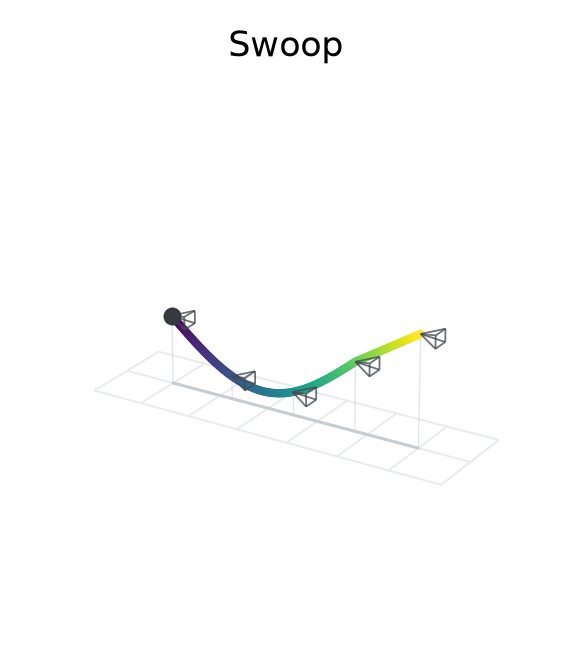
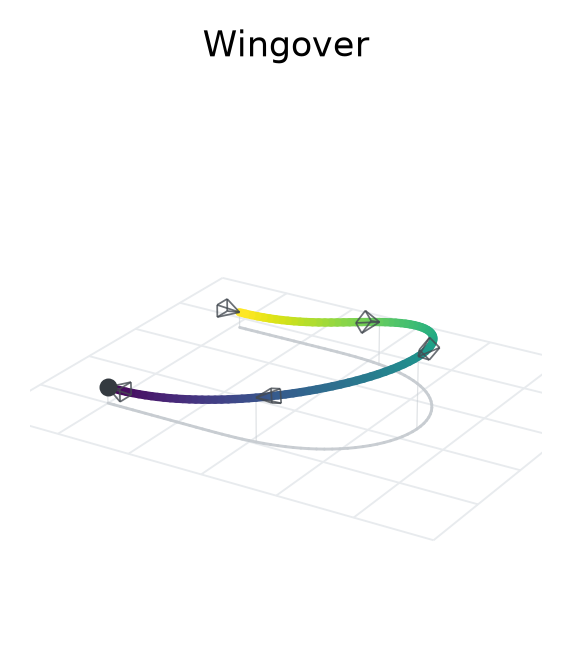
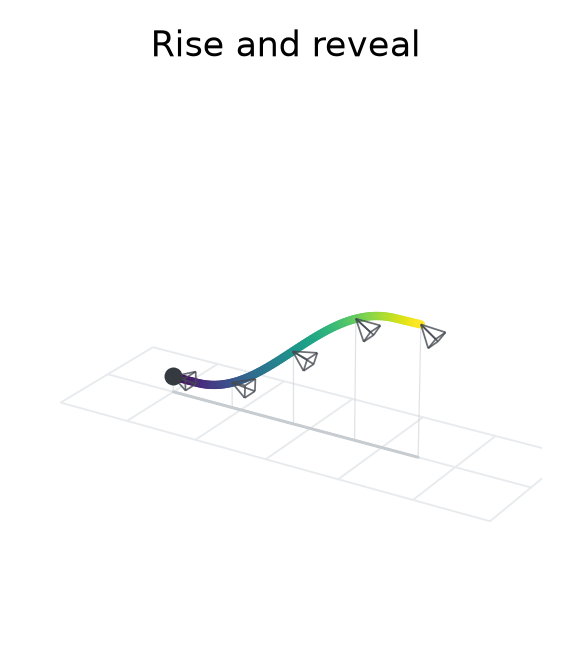
Paper: §4.1 Flight Fidelity and Generalization · Appendix A.1 Additional Flight Comparisons
Does drawing the path actually make the model fly it? The comparison is with camera-controlled video generators — the same task, except they are handed the trajectory as numbers. Each method gets the same first frame, the same prompt and the same seed. We then recover the camera path from every generated video, and measure how far it drifted from the path we asked for. Smooth indoor moves are easy for everyone. Flights that bank, climb and double back are not: the baselines end up 20°–27° off, WorldSlider 6.65° — in four steps instead of 25 or 50.
| Method | Params. | NFE | Standard trajectories | Diverse flights | Quality ↑ | ||
|---|---|---|---|---|---|---|---|
| Rot. ↓ | Trans. ↓ | Rot. ↓ | Trans. ↓ | ||||
| MotionCtrl | 2B | 25 | 11.28 | 0.234 | 27.04 | 0.441 | 3.20 |
| CameraCtrl | 2B | 25 | 5.67 | 0.099 | 26.72 | 0.471 | 3.15 |
| RealCam-I2V | 1.4B | 25 | 7.62 | 0.132 | 24.37 | 0.428 | 2.76 |
| Wan2.1-Camera | 1.3B | 50 | 5.31 | 0.097 | 26.49 | 0.410 | 3.22 |
| HY-WorldPlay | 5B | 4 | 4.11 | 0.152 | 19.93 | 0.378 | 3.53 |
| WorldSlider | 2B | 4 | 2.52 | 0.079 | 6.65 | 0.101 | 3.45 |
Rotation: how far the camera angles drift, in degrees. Translation: the same for position, after removing scale. Quality: Q-Align score. NFE: denoising steps per video. Fifty trajectories per split — RealEstate10K for standard, held-out TartanAir-V2 flights for diverse.
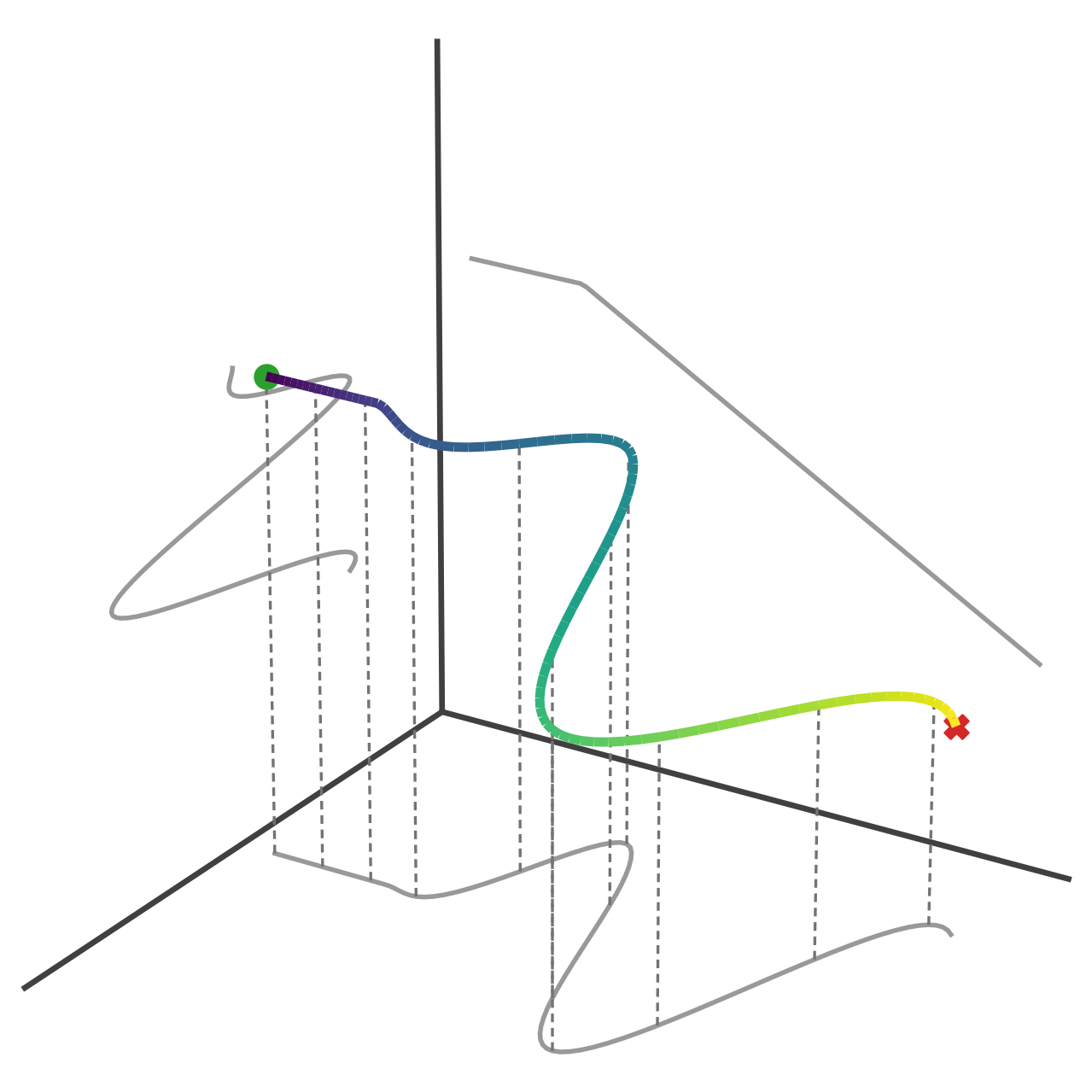
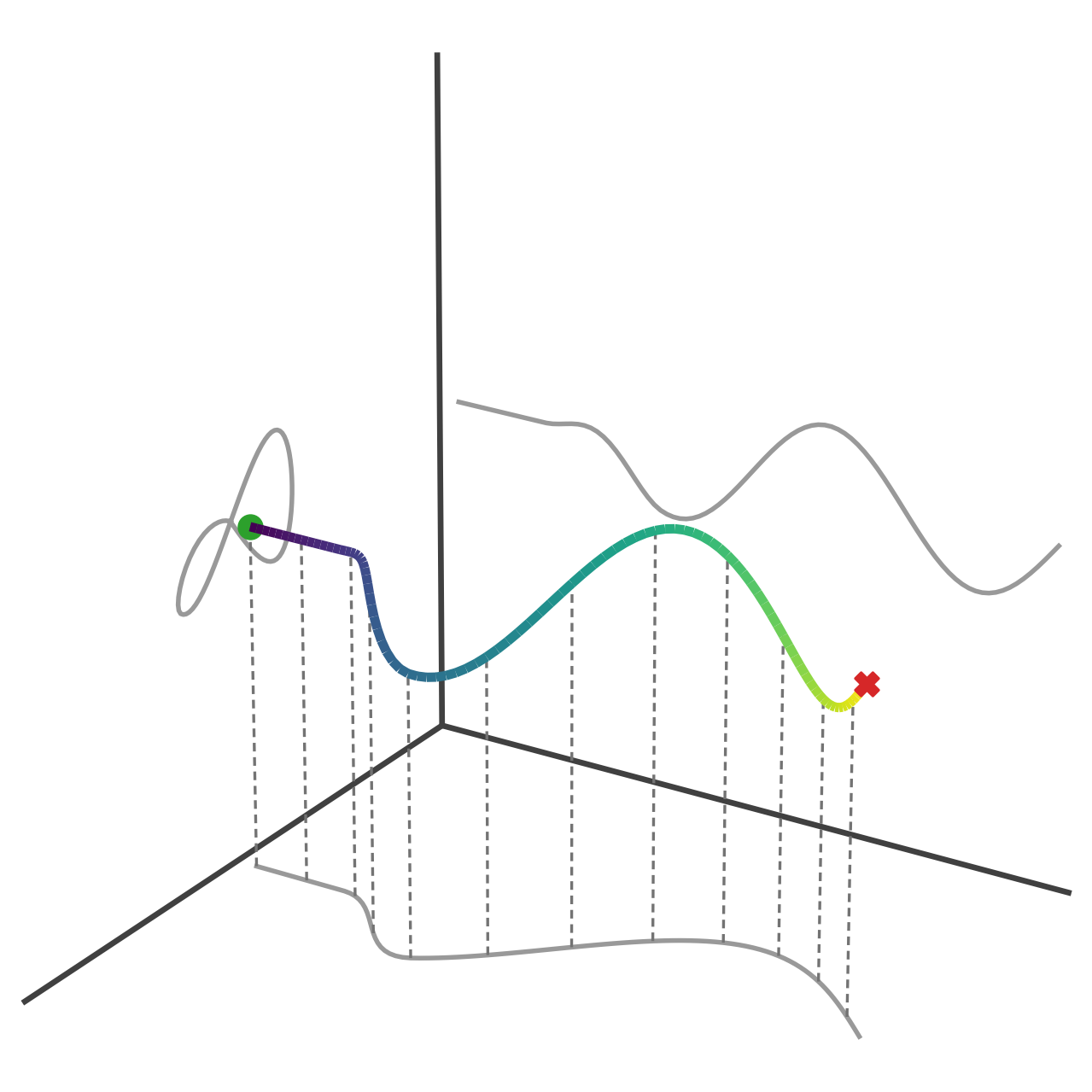
Each panel is one flight. First column: the FlightGrid all six methods were given (top), and the paths they actually flew drawn over the one they were asked for (bottom). Then the six videos, resampled to the same 9.3 s so they play in step. Each method keeps one colour — label, border, curve:
prescribed flight
WorldSlider (ours)
HY-WorldPlay
Wan2.1-Cam
CameraCtrl
MotionCtrl
RealCam-I2V
Paper: §4.2 Parallel Worlds and Applications · Appendix A.2 Parallel Worlds
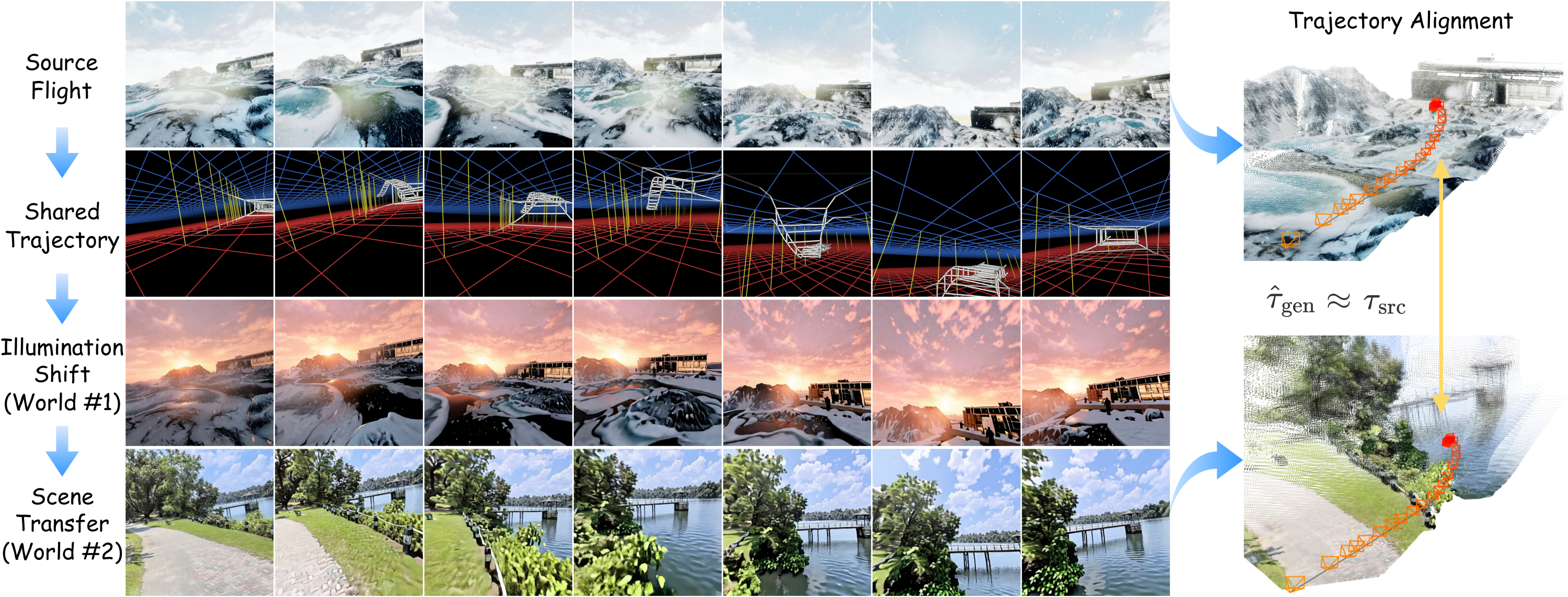
These two flights were written by hand rather than recorded: a falling-leaf descent and a lazy eight. Each becomes a FlightGrid once, then gets paired with different worlds in text. Only the world changes — the descent, the roll and the timing of every turn come from the shared control.


Four more flights, same idea. Left: the path. Then the FlightGrid it becomes, and three worlds generated from it — only the first frame and the text differ between them.


Paper: §4.2 Parallel Worlds and Applications
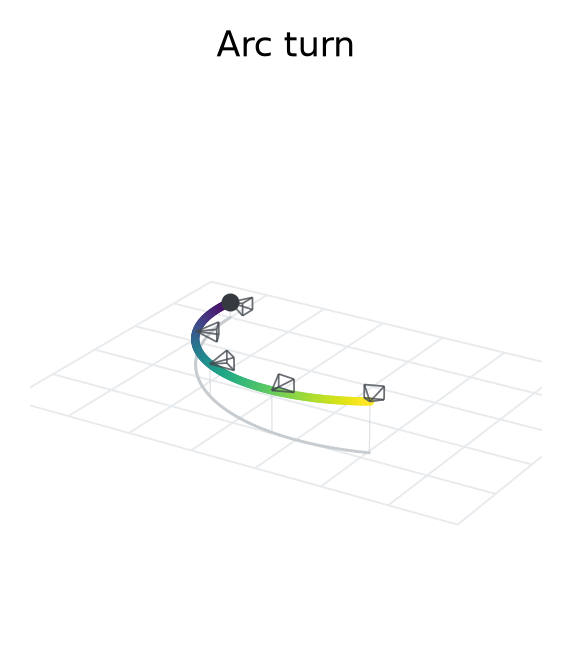
Now the other way round. Both clips start from the same photo, then follow two FlightGrids that turn in different directions. Each one has to imagine a world that fits the photo, and shows only what its own turn reveals. Here the flight plays the part an action input plays in a world model.
Panels: shared first frame · turn left (FlightGrid, generated) · turn right (FlightGrid, generated).
Paper: §4.2 Parallel Worlds and Applications · Appendix A.3 Visual Diversification
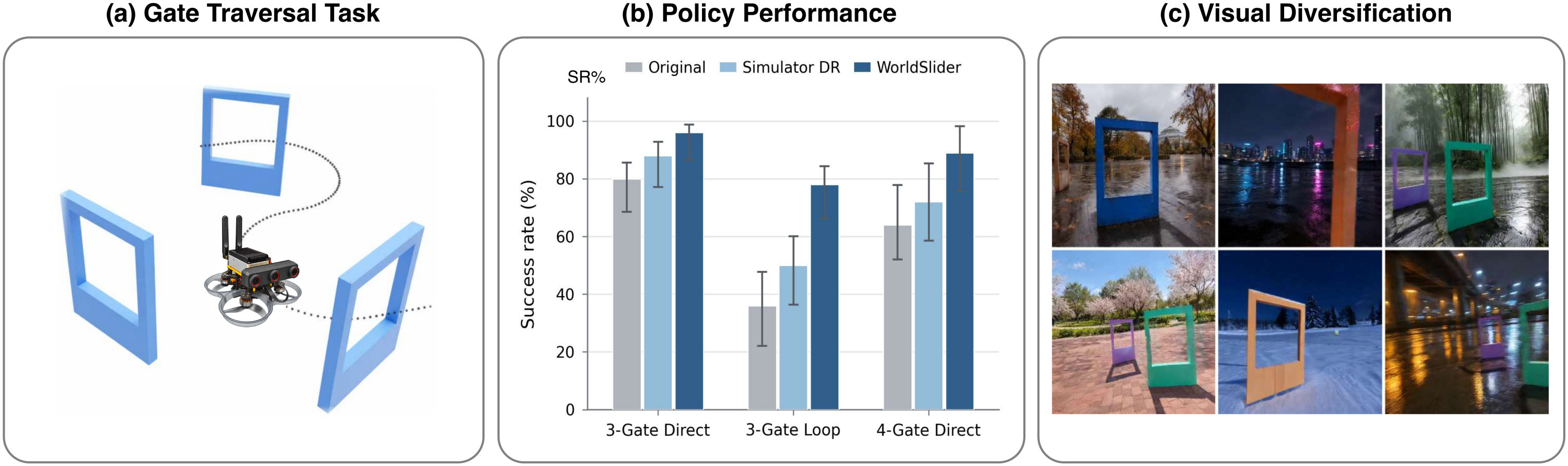
A generated world keeps the flight, so the control actions recorded with the original video still describe it. We used that to train gate-racing policies in Isaac Sim. Every condition sees the same demonstrations and the same training budget; only the images differ — the original recording, simulator randomization, or a WorldSlider world. Policies trained on our worlds win on all three courses, by 28 points on the hardest.
The training images themselves. Left: a recorded gate flight. Right: the same flight re-rendered somewhere else, frame for frame. The gates stay where they were, so the recorded actions still match what the drone does.
Paper: §3 Method
The code release: the FlightGrid renderer, the hook that feeds it into Cosmos-Transfer2.5, the three training stages, the geometry reward and a generation script — in the repository. Turning a pose file into a FlightGrid needs only NumPy, OpenCV and ffmpeg:
python -m worldslider.flightgrid.render poses.txt flightgrid.mp4 --fov 90 --fps 10 --frames 93
@inproceedings{worldslider,
title = {Generating Parallel Worlds of a Flight},
author = {Yan, Keyu and Cao, Wenhan and Wang, Shenao and Yang, Yujie and Wu, Junke and Chen, Xuyang and Zhao, Lin},
booktitle = {TODO},
year = {2027}
}